
System for Atmospheric Modeling
Model History
The System for Atmospheric Modeling, or SAM, has evolved from the Large-Eddy Simulation (LES) model that I coded for a class project while being a Ph.D. student at the University of Oklahoma. Coupled with the explicit or bin microphysics of Yefim Kogan, my Ph.D. advisor, the model has become a useful tool to study detailed cloud processes in the stratocumulus-topped boundary layers (Khairoutdinov and Kogan 1999). As part of my Ph.D thesis, I used the model to develop a bulk microphysics scheme for drizzling PBL clouds, a so-called KK scheme, which has been used in many models as parameterization of autoconversion in warm clouds (Khairoutdinov and Kogan 2000).
Right after completing my PhD studies, in January 1998, I started my work at the Department of Atmospheric Science, Colorado State University, in David Randall's research group. At CSU, the model has undergone major overhaul, both of code and physics. The bin warm-cloud microphysics has been replaced with bulk microphysics that included ice processes. The Bussinesq approximation was changed to anelastic, which allowed to simulate deep convection. The most important change though was to make the model suitable to run on massively parallel computers by using horizontal domain decomposition and employing the MPI communication protocol. The original model has been documented by Khairoutdinov and Randall (2003). In the same year, the model received its official name - SAM - with the version count starting from 6.0, reflecting the fact that SAM represents the sixth cloud-model design since 1987 when I started cloud modeling career at the Central Aerological Observatory (CAO) in the USSR.
Today, SAM is used by dozens cloud modelers in the United States and beyond. Incomplete list of publications of the scientific results obtained using SAM can be found at the end of this page.
SAM currently exists in two major versions. The public version is available for other researchers. It is formulated on the original Cartesian grid, with constant horizontal and variable vertical spacing. The public model follows rather closely the aferomentioned model-description paper, although many changes have been made to the model physics.
Another version is for my own use only and it is not shared with other modeling groups (yet), although many improvements to the public version have come from this experimental version. The fundamental change to the model occured in 2017, when the model formulation has been generalized to longitude-latitude grid to be able to simulate Earth. This version of SAM is currently called Global SAM. The model is described by Khairoutdinov et al (2022).
Model Highlights
The System for Atmospheric Modeling, or SAM, has evolved from the Large-Eddy Simulation (LES) model that I coded for a class project while being a Ph.D. student at the University of Oklahoma. Coupled with the explicit or bin microphysics of Yefim Kogan, my Ph.D. advisor, the model has become a useful tool to study detailed cloud processes in the stratocumulus-topped boundary layers (Khairoutdinov and Kogan 1999). As part of my Ph.D thesis, I used the model to develop a bulk microphysics scheme for drizzling PBL clouds, a so-called KK scheme, which has been used in many models as parameterization of autoconversion in warm clouds (Khairoutdinov and Kogan 2000).
Right after completing my PhD studies, in January 1998, I started my work at the Department of Atmospheric Science, Colorado State University, in David Randall's research group. At CSU, the model has undergone major overhaul, both of code and physics. The bin warm-cloud microphysics has been replaced with bulk microphysics that included ice processes. The Bussinesq approximation was changed to anelastic, which allowed to simulate deep convection. The most important change though was to make the model suitable to run on massively parallel computers by using horizontal domain decomposition and employing the MPI communication protocol. The original model has been documented by Khairoutdinov and Randall (2003). In the same year, the model received its official name - SAM - with the version count starting from 6.0, reflecting the fact that SAM represents the sixth cloud-model design since 1987 when I started cloud modeling career at the Central Aerological Observatory (CAO) in the USSR.
Today, SAM is used by dozens cloud modelers in the United States and beyond. Incomplete list of publications of the scientific results obtained using SAM can be found at the end of this page.
SAM currently exists in two major versions. The public version is available for other researchers. It is formulated on the original Cartesian grid, with constant horizontal and variable vertical spacing. The public model follows rather closely the aferomentioned model-description paper, although many changes have been made to the model physics.
Another version is for my own use only and it is not shared with other modeling groups (yet), although many improvements to the public version have come from this experimental version. The fundamental change to the model occured in 2017, when the model formulation has been generalized to longitude-latitude grid to be able to simulate Earth. This version of SAM is currently called Global SAM. The model is described by Khairoutdinov et al (2022).
Model Highlights
- Anelastic dynamical core;
- Prognostic liquid/ice water static energy, and non-precipitating (cloud water/ice) and precipitating water(rain/snow/graupel);
- Several microphysics packages, including Morrison and Thompson schemes;
- 1.5-order sub-grid scale closure (prognostic SGS TKE) or Smagorinsky-type closure;
- Radiation from CAM3 or RRTM;
- Periodical domain with the option of solid lateral walls;
- Surface fluxes based on Monin-Obukhov similarity;
- ISCCP, MODIS, and MISR cloud simulators;
- Simple mixed-layer ocean;
- Option to run on latitude-longitude grid (Global SAM only)
- Block-fill topography (Global SAM only)
- Simplfied Land Model with vegetation and interactive soil (Lee, J. M., and M. Khairoutdinov, JAMES, 2015)
- Parallel (MPI).
Examples of simulations with Global SAM - Domain: 5120x2560x34, dx=4km; SST: QOBS profile from APE;
animation
- Domain: 1024x1024x64, dx=2km; tropospheric shear 5 m/s;
animation
- Based on average forcing and sounding from GATE Phase III
observations (30 August - 19 September 1074, Tropical Atlantic);
- Forcing: SST, horizontal advective tendencies of s and q; mean wind nudged to observed; radiative heating prescribed; surface fluxes - interactive.
- Domain: 2048x2048x256 grid points, or 205x205x27 km3 (horizontal grid spacing 100m);
- Vertical grid spacing: 50m below 1km, 50-100m @1-5km; 100m @5-18km; 100-300m above;
- Time step: 2 sec, duration: 1 day;
- Initialization: random small-amplitude noise in temperature near the surface;
- run done over 6 days wall-clock time on 2048 processors of IBM
BlueGene BG/L
- Snapshot of a cloud scene at full model resolution (180x180
km2): download (3.6 MB)
- Snapshot of a small part of a cloud scene made by Ian Glenn (U.Utah)
: download (3.6 MB)
- Animations of mock-up cloud albedo as would be seen from a
satellite orbit (15 simulated minutes per mpvie second); you will need
a
Quicktime player; for PC download QT for free from here:
- One day evolution whole domain: download (102 MB);
- Zoom-in into a quarter of a domain (100x100 km2) for 13.5 hours: download (91 MB);
- Zoom-in into a 50x50 km2 subdomain for 2h40m download (4.9 MB);
- 23 July - 15 September 1999: 52 days, Kwajalein Atoll,
Marshall Islands.
- Forcing: SST, horizontal advective tendencies of s and q;
large-scale vertical velocity; mean wind nudged to observed.
Radiation and surface fluxes - interactive.
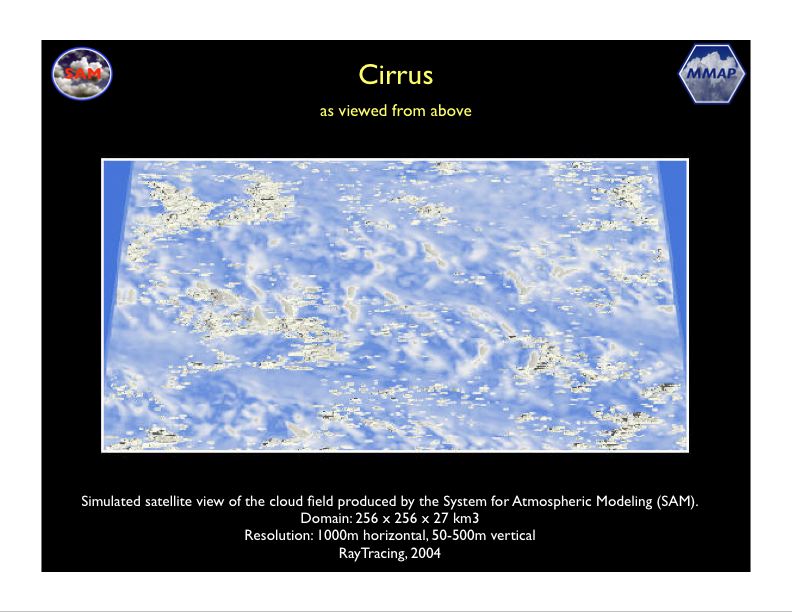
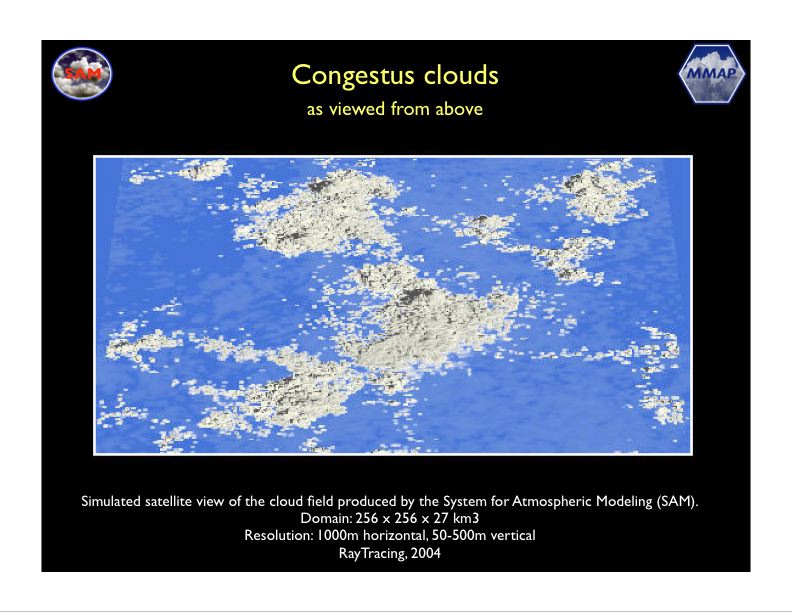
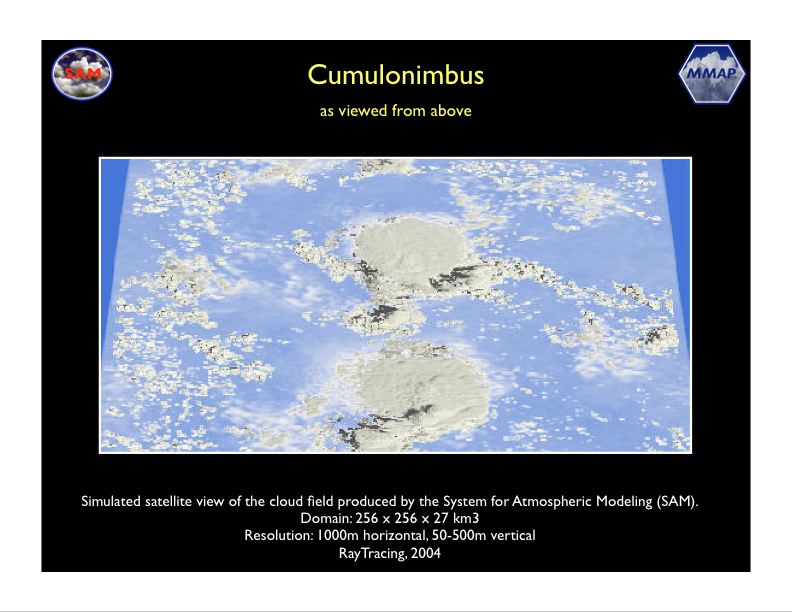
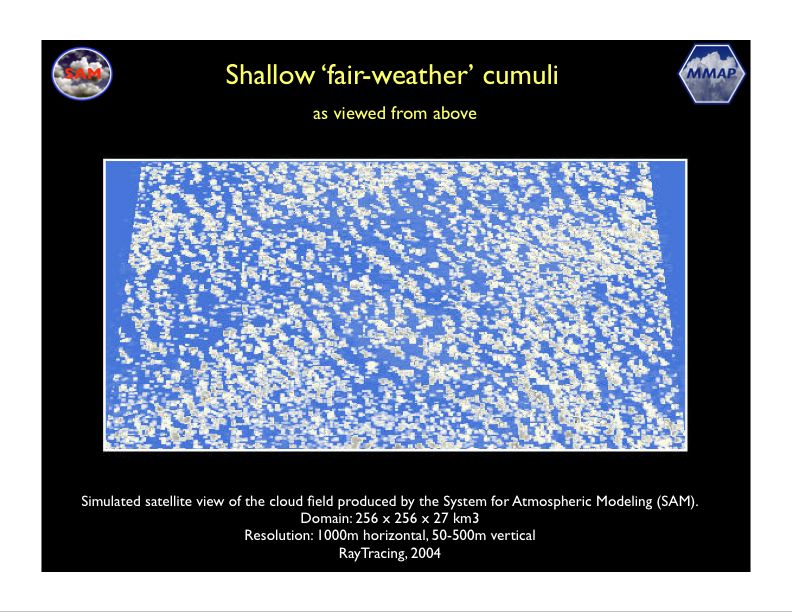
Domain: 256x256x64 grid points, or 256x256x27 km3, time step: 10 sec, duration: 52 days - Snapshots of variuos cloud regimes: cirrus, squall-line, congestus, cumulonimbus, small cumuli
- Animation of a 4-hour period of active deep convection as if viewed from a satellite: full (16 mb), small (4.4 mb)
- Animation of the whole 52-day period as if viewed
from a satellite: full (113 Mb),
small
(33 Mb)
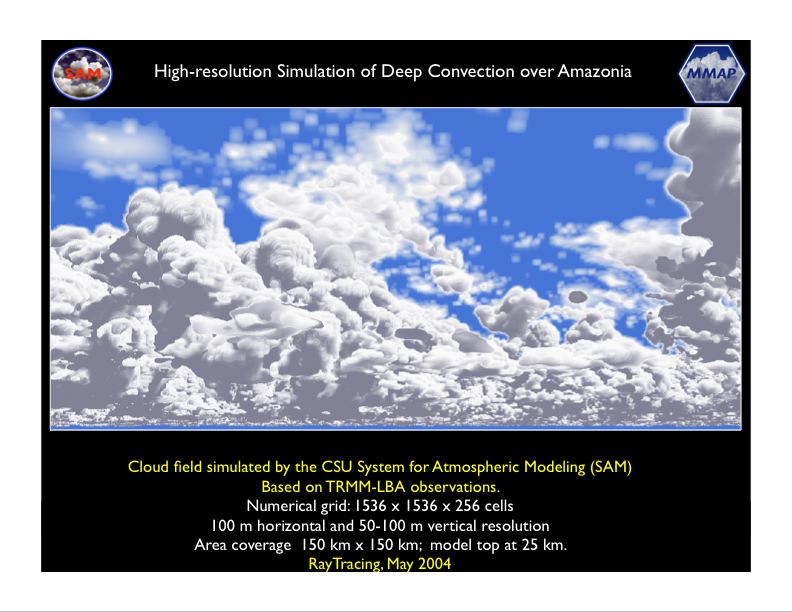
- Based on TRMM-LBA Case 3 of the GCSS WG4;
- Domain: 1536 x 1536 x 256 grid points, or 154 x 154 x 25 km3
- Horizontal resolution: 100 m, vertical resolution: 50 m in PBL, 100 m in troposphere, 150-200 m in stratosphere
- Time step: 2 sec; duration 6 hours.
- Forcing: Prescribed surface fluxes and radiative cooling.
- Case description: Starts early morning when no clouds present. About 2 hours into simulation, shallow convection develops gradually growing into mid-level convection with the transition to deep convection by the simulation end.
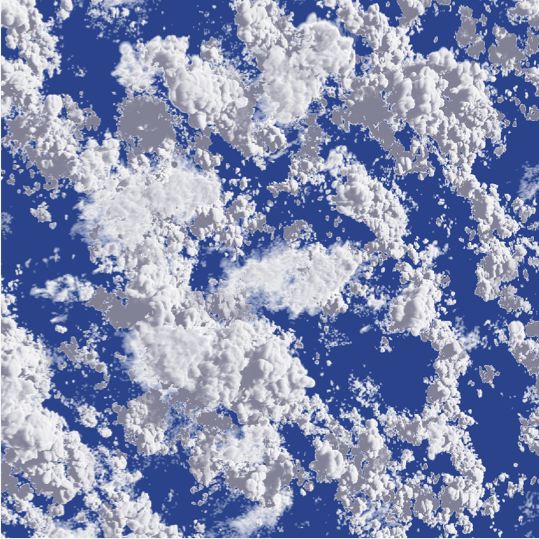
- Snapshot of the cloud field at the end of simulation: pdf (1.5 Mb), jpg (80 kb). Note that the clouds tops are as high as 12 km.
- Snapshot of a view from a satellite: pdf
(620 kb), jpg (104 kb), and zoom into
one
quarter of the domain: pdf (540
kb), jpg (96 kb).
- Rotating cloud field at the end of simulation: full (35 Mb), small (10.4 Mb)
- Goncalves, L. J. M., Coelho, S. M. S. C., Kubota, P. Y., and Souza, D. C.: Interaction between cloud-radiation, atmospheric dynamics and thermodynamics based on observational data from GoAmazon 2014/15 and a cloud-resolving model, Atmos. Chem. Phys., 22, 15509-15526, https://doi.org/10.5194/acp-22-15509-2022, 2022.
- Sokol, A. B., and Hartmann, D. L., 2022: Radiative Cooling, Latent Heating, and Cloud Ice in the Tropical Upper Troposphere. Journal of Climate 35, 5, 1643-1654, https://doi.org/10.1175/JCLI-D-21-0444.1
- Mpanza M. A. T., and N. F. Tandon, 2022: Further probing the mechanisms driving projected decreases of extreme precipitation intensity over the subtropical Atlantic. Climate Dyn., 59, doi:10.1007/s00382-022-06268-3.
- Ong, H., and D. Yang, 2022: The compressional beta effect and convective system propagation. J. Atmos. Sci., 79, 2031-2040, https://doi.org/10.1175/JAS-D-21-0219.1.
- Carstens, J.D. and A.A. Wing (2022): A spectrum for convective self-aggregation based on background rotation, J. Adv. Model. Earth Syst., 14, e2021MS002860, doi:10.1029/2021MS002860.
- Carstens, J.D. and A.A. Wing (2022): Simulating Dropsondes to Assess Moist Static Energy Variability in Tropical Cyclones, Geophys. Res. Lett., doi:10.1029/2022GL099101.
- Sokol, A. B., & Hartmann, D. L., 2022: Congestus mode invigoration by convective aggregation in simulations of radiative-convective equilibrium. Journal of Advances in Modeling Earth Systems, 14, e2022MS003045. https://doi.org/10.1029/2022MS003045
- Gristey, J. J., G. Feingold, K. S. Schmidt, and H. Chen, 2022: Influence of aerosol embedded in shallow cumulus cloud fields on the surface solar irradiance. Journal of Geophysical Research: Atmospheres, 127, e2022JD036822. https://doi.org/10.1029/2022JD036822
- Wyant, M. C., Bretherton, C. S., Wood, R., Blossey, P. N., & McCoy, I. L., 2022: High free-tropospheric Aitken-mode aerosol concentrations buffer cloud droplet concentrations in large-eddy simulations of precipitating stratocumulus. J. Adv. Model. Earth Sys., 14, e2021MS002930. https://doi.org/10.1029/2021MS002930
- Singh, M.S. & Neogi, S (2022). On the interaction between moist convection and large-scale ascent in the tropics. J. Climate, 35, 4417-4434, doi:10.1175/JCLI-D-21-0717.1.
- Singh, M.S. & O'Neill, M.E (2022). The climate system and the second law of thermodynamics, Reviews of Modern Physics, 94, 015001, doi:10.1103/RevModPhys.94.015001.
- Pinsky M., and A. Khain, 2022: Convective and turbulent motions in non-precipitating Cu. Part III: Characteristics of turbulence motions. J. Atmos. Sci. (in press)
- Pinsky M., E. Eytan, I. Koren, and A. Khain, 2022: Convective and turbulent motions in non-precipitating Cu. Part II: LES simulated cloud represented by a starting plume. J. Atmos. Sci., 79, 793-813, DOI: 10.1175/JAS-D-21-0137.1
- Eytan, E., A. Khain, M. Pinsky, O. Altaratz, J.Shpund, and I. Koren, 2022: Shallow Cumulus Properties as Captured by Adiabatic Fraction in High-Resolution LES Simulations. J. Atmos. Sci.79, 409–428; doi:10.1175/JAS-D-21-0201.1.
- Covert, J. A., D. B. Mechem, and Z. Zhang, 2022: Subgrid-scale Horizontal and Vertical Variations of Cloud Water in Stratocumulus Clouds: A case study based on LES and comparisons with in-situ observations. Atmos. Chem. Phys., 22, 1159–1174, https://doi.org/10.5194/acp-22-1159-2022.
- Yao, L., D. Yang and Z.-M. Tan, 2022: A Vertically Resolved MSE Framework Highlights the Role of the Boundary Layer in Convective Self-Aggregation. Journal of the Atmospheric Sciences. doi: 10.1175/JAS-D-20-0254.1
- Feingold, G., T. Goren, and T. Yamaguchi, 2022: Quantifying albedo susceptibility biases in shallow clouds. Atmos. Chem. Phys., 22, 3303-3319, doi:10.5194/acp-22-3303-2022.
- Yoshida, R., T. Yamaguchi, and G. Feingold, 2022: Two-dimensional idealized Hadley circulation simulation for global high resolution model development. J. Adv. Model. Earth Syst., 14, e2021MS002714, doi:10.1029/2021MS002714.
- Muller C., D. Yang, G. Craig, T. Cronin, B. Fildier, J. O. Haerter, C. Hohenegger, B. Mapes, D. Randall, S. Shamekh, S. Sherwood, 2022: Spontaneous Aggregation of Convective Storms. Annual Review of Fluid Mechanics, 54, https://doi.org/10.1146/annurev-fluid-022421-011319
- Abramian S., Muller C., Risi C., 2022: Shear-convection interactions and orientation of tropical squall lines. Geophysical Research Letters, 49, https://doi. org/10.1029/2021GL095184
- Zheng, Y., Zhang, H., & Li, Z. (2021). Role of surface latent heat flux in shallow cloud transitions: A mechanism-denial LES study. Journal of the Atmospheric Sciences, 78(9), 2709-2723.
- Zheng, Y., Zhang, H., Rosenfeld, D., Lee, S. S., Su, T., & Li, Z. (2021). Idealized Large-Eddy Simulations of Stratocumulus Advecting over Cold Water. Part I: Boundary Layer Decoupling. Journal of the Atmospheric Sciences, 78(12), 4089-4102.
- Da Silva N., Muller C., Shamekh S., Fildier B., 2021: Significant amplification of instantaneous extreme precipitation with convective self-aggregation. Journal of Advances in Modeling Earth Systems, 13, https://doi. org/10.1029/2021MS002607
- Kazil, J., M. W. Christensen, S. J. Abel, T. Yamaguchi, and G. Feingold, 2021: Realism of Lagrangian Large Eddy Simulations Driven by Renalysis Meteorology: Tracking a Pocket of Open Cells Under a Biomass Burning Aerosol Layer. J. Adv. Model. Earth Syst., 13, e2021MS002664, doi:10.1029/2021MS002664.
- Narenpitak, P., J. Kazil, T. Yamaguchi, P. Quinn, and G. Feingold, 2021: From sugar to flowers: A transition of shallow cumulus organization during ATOMIC. J. Adv. Model. Earth Syst., 13, e2021MS002619, doi:10.1029/2021MS002619.
- Hoffmann, F., and G. Feingold, 2021: Cloud Microphysical Implications for Marine Cloud Brightening: The Importance of the Seeded Particle Size Distribution, J. Atmos. Sci., 78, 3247-3262, doi:10.1175/JAS-D-21-0077.1.
- Glassmeier, F., F. Hoffmann, J. S. Johnson, T. Yamaguchi, K. S. Carslaw, and G. Feingold, 2021: Novel constraint on liquid-water path response to aerosol perturbations cautions against suitability of ship-track studies for inferring effective forcing. Science, 371, 485-489, doi:10.1126/science.abd3980.
- Roy, R. J., Lebsock, M., and Kurowski, M. J.: Spaceborne differential absorption radar water vapor retrieval capabilities in tropical and subtropical boundary layer cloud regimes, Atmos. Meas. Tech., 14, 6443–6468, https://doi.org/10.5194/amt-14-6443-2021, 2021.
- Eytan, E., Koren, I., Altaratz, O., Pinsky, M., and Khain, A.: Revisiting adiabatic fraction estimations in cumulus clouds: high-resolution simulations with a passive tracer, Atmos. Chem. Phys., 21, 16203–16217, https://doi.org/10.5194/acp-21-16203-2021, 2021.
- Pinsky M., Eshkol Eytan, Ilan Koren, Orit Altaratz and A. Khain, 2021: Convective and Turbulent Motions in Nonprecipitating Cu. Part I: Method of Separation of Convective and Turbulent Motions J. Atmos. Sci., 2307–2321, https://doi.org/10.1175/JAS-D-20-0127.1
- Abbott, T and T. Cronin, 2021: Aerosol invigoration of atmospheric convection through increases in humidity. Science, 371, 83-85. doi:10.1126/science.abc5181
- O'Gorman, P. A., Li, Z., Boos, W. R. & Yuval, J. 2021 Response of extreme precipitation to uniform surface warming in quasi-global aquaplanet simulations at high resolution Philosophical Transactions A 379, 20190543.
- Yuval, J., O'Gorman, P. A. & Hill, C. N. 2021 Use of neural networks for stable, accurate and physically consistent parameterization of subgrid atmospheric processes with good performance at reduced precision Geophysical Research Letters 48, e2020GL091363 .
- Risi, C., Muller, C., & Blossey, P., 2021: Rain evaporation, snow melt and entrainment at the heart of water vapor isotopic variations in the tropical troposphere, according to large-eddy simulations and a two-column model. J. Adv. Model. Earth Sys., 13, e2020MS002381. https://doi.org/10.1029/2020MS002381
- Blossey, P. N., C. S. Bretherton and J. Mohrmann, 2021: Simulating observed cloud transitions in the northeast Pacific during CSET. Monthly Weather Review, 149(8), 2633-2658, https://doi.org/10.1175/MWR-D-20-0328.1
- Atlas, R., C. S. Bretherton, P. N. Blossey, A. Gettelman, C. Bardeen, P. Lin and Y. Ming, 2020: How well do large-eddy simulations and global climate models represent observed boundary layer structures and low clouds over the summertime Southern Ocean? J. Adv. Model. Earth Sys., 12, e2020MS002205. https://doi.org/10.1029/2020MS002205
- Risi, C., Muller, C., & Blossey, P., 2020: What controls the water vapor isotopic composition near the surface of tropical oceans? Results from an analytical model constrained by large-eddy simulations. J. Adv. Model. Earth Sys., 12, e2020MS002106. https://doi.org/10.1029/2020MS002106
- Lonsdale, C. R., Alvarado, M. J., Hodshire, A. L., Ramnarine, E., and Pierce, J. R., 2020: Simulating the forest fire plume dispersion, chemistry, and aerosol formation using SAM-ASP version 1.0, Geosci. Model Dev., 13, 4579-4593, https://doi.org/10.5194/gmd-13-4579-2020,
- Hansen, Z.R., Back, L.E., and Zhou 2020: Boundary Layer Quasi-Equilibrium Limits Convective Intensity Enhancement from the Diurnal Cycle in Surface Heating, J. Atmos. Sci.
- Yuval, J., O'Gorman, P.A. Stable machine-learning parameterization of subgrid processes for climate modeling at a range of resolutions. Nat Commun 11, 3295 (2020). https://doi.org/10.1038/s41467-020-17142-3
- McMichael, L. A., F. Yang, T. Marke, U. Löhnert, D. B. Mechem, A. M. Vogelmann, et al., 2020: Characterizing subsiding shells in shallow cumulus using Doppler lidar and large‐eddy simulation. Geophysical Research Letters, 47, e2020GL089699. https://doi.org/10.1029/2020GL089699
- Fildier, B., Collins, W. D., & Muller, C. (2020). Distortions of the rain distribution with warming, with and without self‐aggregation. Journal of Advances in Modeling Earth Systems, 13. https://doi.org/10.1029/2020ms002256
- Brenowitz, N., T. Beucler, M. Pritchard & C. Bretherton, 2020: Interpreting and Stabilizing Machine-Learning Parametrizations of Convection. arXiV, 2003.06549.
- Beucler, T., D. Leutwyler & J. Windmiller, 2020: Quantifying Convective Aggregation Using the Tropical Moist Margin's Length. arXiv, 2002.11301.
- Beucler, T. et al., 2020: Enforcing Analytic Constraints in Neural-Networks Emulating Physical Systems. arXiv, 1909.00912.
- Abbott, T., T. Cronin & T. Beucler, 2020: Convective dynamics and the response of precipitation extremes to warming in radiative-convective equilibrium. Journal of the Atmospheric Sciences, 77, 1637-1660.
- Warren, R.A., Singh, M.S. & Jakob, C.J. (2020). Simulations of radiative-convective-dynamical equilibrium, J. Adv. Model. Earth Syst., doi:10.1029/2019MS001734. Shamekh S., C. Muller, J.-P. Duvel, F. D'Andrea, 2020: Self-aggregation of convective clouds with interactive sea surface temperature. Journal of Advances in Modeling Earth Systems, 12, https://doi.org/10.1029/2020MS002164
- Muller C., Y. Takayabu, 2020: Response of precipitation extremes to warming: what have we learned from theory and idealized cloud-resolving simulations, and what remains to be learned? Environmental Research Letters, 15, 035001, https://doi.org/10.1088/1748-9326/ab7130
- Shamekh S., C. Muller, J.-P. Duvel, F. D'Andrea, 2019: How do ocean warm anomalies favor the aggregation of deep convective clouds? Journal of the Atmospheric Sciences, https://doi.org/10.1175/JAS-D-18-0369.1
- Singh, M.S., Warren, R.A. & Jakob, C.J. (2019). A steady-state model for the relationship between humidity, instability, and precipitation in the tropics, J. Adv. Model. Earth Syst., 11, doi:10.1029/2019MS001686.
- Khain P., R. Heiblum, U. Blahak, Y. Levi, H. B. Muskatel, E. Vadislavsky, O. Altaratz, I. Koren, G. Dagan, J. Shpund and A.P. Khain , 2019: Parameterization of vertical profiles of governing microphysical parameters of shallow cumulus cloud ensembles using LES with bin microphysics. J. Atmos. Sci. 76, 2, 533–560, https://doi.org/10.1175/JAS-D-18-0046.1
- Beucler, T., T. Abbott, T. Cronin & M. Pritchard, 2019: Comparing Convective Self-Aggregation in Idealized Models to Observed Moist Static Energy Variability Near the Equator. Geophysical Research Letters, 46, 17-18.
- Hoffmann, F., F. Glassmeier, T. Yamaguchi, and G. Feingold, 2020: Liquid Water Path Steady States in Stratocumulus: Insights From Process-Level Emulation and Mixed-Layer Theory. J. Atmos. Sci., 77, 2203-2215, doi: 10.1175/JAS-D-19-0241.1.
- Angevine, W., M., J. Olson, J. J. Gristey, I. Glenn, G. Feingold, and D. D. Turner, 2020: Scale awareness, resolved circulations, and practical limits in the MYNN-EDMF boundary layer and shallow cumulus scheme. Monthly Weath. Rev., https://doi.org/10.1175/MWR-D-20- 0066.1.
- Gristey, J. J., G. Feingold, I. B. Glenn, K. S Schmidt, and H. Chen, 2020: On the relationship between shallow cumulus cloud field properties and surface solar irradiance. Geophys. Res. Lett., 47, e2020GL090152. https://doi.org/10.1029/2020GL090152.
- Glenn, I. B., G. Feingold, J. J. Gristey, and T. Yamaguchi, 2020: Quantification of the radiative effect of aerosol–cloud interactions in shallow continental cumulus clouds. Journal of the Atmospheric Sciences, 77, 2905-2920, doi:10.1175/JAS-D-19-0269.1.
- Lunderman, S., M. Morzfeld, F. Glassmeier, and G. Feingold, 2020: Estimating parameters of the nonlinear cloud and rain equation from large-eddy simulations, Physica D, https://doi.org/10.1016/j.physd.2020.132500.
- Carstens, J. and A.A. Wing, (2020): Tropical cyclogenesis from self-aggregated convection in numerical simulations of rotating radiative-convective equilibrium, J. Adv. Model. Earth Syst., 12, e2019MS002020, doi:10.1029/2019MS002020.
- Gristey, J. J., G. Feingold, I. B. Glenn, K. S Schmidt, and H. Chen, 2020: Surface solar irradiance in continental shallow cumulus fields: Observations and large eddy simulation J. Atmos. Sci., https://doi.org/10.1175/JAS-D-19-0261.1.
- Goren, T., J. Kazil, F. Hoffmann, T. Yamaguchi, and G. Feingold, 2019: Anthropogenic air pollution delays marine stratocumulus breakup to open cells. Geophys. Res. Lett., 46, 14135-14144, doi:10.1029/2019GL085412.
- Yamaguchi, T., G. Feingold, and J. Kazil, 2019: Aerosol-cloud interactions in trade wind cumulus clouds and the role of vertical wind shear. J. Geophys. Res., 124, 12244-12261, doi:10.1029/2019JD031073.
- Pope, C. A., J. P. Gosling, S. Barber, J. S. Johnson, T. Yamaguchi, G. Feingold, and P. G. Blackwell, 2019: Gaussian process modeling of heterogeneity and discontinuities using voronoi tessellations. Technometrics, 1-20, doi:10.1080/00401706.2019.1692696.
- Klinger, C., G. Feingold, and T. Yamaguchi, 2019: Cloud droplet growth in shallow cumulus clouds considering 1-D and 3-D thermal radiative effects. Atmos. Chem. Phys., 19, 6295-6313, doi:10.5194/acp-19-6295-2019.
- Glassmeier, F., F. Hoffmann, J. S. Johnson, T. Yamaguchi, K. S. Carslaw, and G. Feingold, 2019: An emulator approach to stratocumulus susceptibility. Atmos. Chem. Phys., 19, 10191-10203, doi:10.5194/acp-19-10191-2019.
- McMichael, L. A., D. B. Mechem, S. Wang, Q. Wang, Y. L. Kogan, and J. Teixeira, 2019: Assessing the mechanisms governing the daytime evolution of marine stratocumulus using large-eddy simulation. Quart. J. Roy. Meteor. Soc., 145, 845–866.
- Hoffmann, F., and G. Feingold, 2019: Entrainment and Mixing in Stratocumulus: Effects of a New Explicit Subgrid-Scale Scheme for Large-Eddy Simulations with Particle-Based Microphysics. J. Atmos. Sci., 76, 1955-1973, doi:10.1175/JAS-D-18-0318.1.
- Tian, Y., Z. Kuang, S. Martin and J. Nie. 2019. The vertical momentum budget of shallow cumulus convection: insights from a Lagrangian perspective. Journal of Advances in Modeling Earth System. 11, DOI: 10.1029/2018MS001451
- Hartmann, D. L., P. N. Blossey and B. D. Dygert, 2019: Convection and Climate: What Have We Learned from Simple Models and Simplified Settings? Curr. Clim. Change. Rep., doi:10.1007/s40641-019-00136-9
- Gasparini, B., P. N. Blossey, D. L. Hartmann, G. Lin and J. Fan, 2019: What drives the lifecycle of tropical anvil clouds? J. Adv. Model. Earth Syst., 11. https://doi.org/10.1029/2019MS001736
- Hartmann, D. L., B. Gasparini, S. E. Berry and P. N. Blossey, 2018: The Life Cycle and Net Radiative Effect of Tropical Anvil Clouds. J. Adv. Model. Earth Syst., 10, 3012-3029. https://doi.org/10.1029/2018MS001484
- Hoffmann, F., T. Yamaguchi, and G. Feingold, 2018: Inhomogeneous Mixing in Lagrangian Cloud Models: Effects on the Production of Precipitation Embryos. J. Atmos. Sci., 76, 113-133, doi:10.1175/JAS-D-18-0087.1.
- Beucler, T. & T. Cronin, 2018: A Budget for the Size of Convective Self-Aggregation. Quarterly Journal of the Royal Meteorological Society, 145, 947-966.
- Beucler, T., T. Cronin & K. Emanuel, 2018: A Linear Response Framework for Radiative-Convective Instability. Journal of Advances in Modeling Earth Systems, 10(8), 1924-1951.
- Blossey P. N. , C. S. Bretherton, J. A. Thornton and K. S. Virts, 2018. Locally enhanced aerosols over a shipping lane produce convective invigoration but weak overall indirect effects in cloud-resolving simulations Geophys. Res. Lett., 45, 9305-9313, https://doi.org/10.1029/2018GL078682
- Khairoutdinov, M., and K. Emanuel, 2018: Intraseasonal Variability in a Cloud- Permitting Near-Global Equatorial Aqua-Planet Model. J. Atmos. Sci. doi:10.1175/JAS-D-18-0152.1, in press
- Mechem, D. B., and S. E. Giangrande, 2018: Controls on cloud properties and precipitation onset for a case of cumulus congestus sampled during MC3E. J. Geophys. Res. Atmos., 123, https://doi.org/10.1002/2017JD027457
- Dagan, G., I. Koren, and O. Altaratz, 2018: Quantifying the effect of aerosol on vertical velocity and effective terminal velocity in warm convective clouds. Atmospheric Chemistry and Physics, 18, 6761-6769. https://doi.org/10.5194/acp-18-6761-2018
- Tian Y., and Z. Kuang. 2018. Why does deep convection have different sensitivities to temperature perturbations in the lower and upper troposphere? Journal of Atmospheric Sciences. 76: 27-41. DOI: 10.1175/JAS-D-18-0023.1
- Dagan, G., I. Koren, A. Kostinski, and O. Altaratz, 2018: Organization and oscillations in simulated shallow convective clouds. Journal of Advances in Modeling Earth Systems. https://doi.org/10.1029/2018MS001416
- Nie, J., H. Sobel, D. A. Shaevitz, and S. Wang, 2018: Dynamic Amplification of Extreme Precipitation Sensitivity, Proc. Natl. Acad. Sci., 115, 9467-9472.
- Wing, A. A., K.A. Reed, M. Satoh, B. Stevens, S. Bony, and T. Ohno (2018): Radiative-Convective Equilibrium Model Intercomparison Project, Geosci. Model Dev., 11, 793-813, doi:10.5194/gmd-11-793-2018.
- Yang, D. (2018). Boundary Layer Height and Buoyancy Determine the Horizontal Scale of Convective Self-Aggregation, j. Atmos. Sci., 75, 469-478. 10.1029/2017MS001261
- Yang, D. (2018). Boundary layer diabatic processes, the virtual effect, and convective self-aggregation. Journal of Advances in Modeling Earth Systems, 10. https://doi.org/10.1029/2017MS001261
- Wyant M., C.S. Bretherton, and P. N. Blossey, 2018. The Numerical Effects of Cross-Grid Flow in Simulations of the Marine Boundary Layer J. Adv. Model. Earth Syst., 10, 466-480, https://doi.org/10.1002/2017MS001241
- Muller C., D. Romps, 2018: Acceleration of tropical cyclogenesis by self-aggregation feedbacks. Proceedings of the National Academy of Sciences, 201719967; DOI: 10.1073/pnas.1719967115
- Zuidema P., G. Torri, C. Muller, A. Chandra, 2017: A survey of precipitation-induced atmospheric cold pools over oceans and their interactions with the larger-scale environment. Surveys in Geophysics, 38: 1283. https://doi.org/10.1007/s10712-017-9447-x
- Holloway C. , A. Wing, S. Bony, C. Muller, H. Masunaga, T. L'Ecuyer, D. Turner, P. Zuidema, 2017: Observing Convective Aggregation. Surveys in Geophysics, doi: 10.1007/s10712-017-9419-1
- Wing A., K. Emanuel, C. Holloway, C.J. Muller, 2017: Convective self-aggregation in numerical simulations : a review. Surveys in Geophysics, doi: 10.1007/s10712-017-9408-4
- Bretherton C. S.and P. N. Blossey, 2017. Understanding mesoscale aggregation of shallow cumulus convection using large-eddy simulation. J. Adv. Model. Earth Syst., 9, 2798-2821, https://doi.org/10.1002/2017MS000981
- Neggers R. and coauthors, 2017. Single-column model simulations of subtropical marine boundary-layer cloud transitions under weakening inversions. J. Adv. Model. Earth Syst., 9, 2385-2412, doi:10.1002/2017MS001064
- Yamaguchi, T., G. Feingold, and J. Kazil (2017), Stratocumulus to cumulus transition by drizzle, J. Adv. Model. Earth Syst., 9(6), 2333-2349, doi:10.1002/2017MS001104.
- Roesler, E. L., D. J. Posselt, and R. B. Rood (2017), Using large eddy simulations to reveal the size, strength, and phase of updraft and downdraft cores of an Arctic mixed‐phase stratocumulus cloud, J. Geophys. Res. Atmos., 122, 4378–4400, doi: 10.1002/2016JD026055.
- Kazil, J., T. Yamaguchi, and G. Feingold (2017), Mesoscale organization, entrainment, and the properties of a closed-cell stratocumulus cloud, J. Adv. Model. Earth Syst., 9(5), 2214-2229, doi:10.1002/2017MS001072.
- Remillard, J., A. M. Fridlind, A. S. Ackerman, G. Tselioudis, P. Kollias, D. B. Mechem, H. E. Chandler, E. Luke, R. Wood, M. K. Witte, P. Y. Chuang, and J. K. Ayers, 2017: Use of cloud radar Doppler spectra to evaluate stratocumulus drizzle size distributions in large-eddy simulations with size-resolved microphysics. J. Appl. Meteor. Climatol., 56, 3263–3283
- Feingold, G., J. Balsells, F. Glassmeier, T. Yamaguchi, J. Kazil, and A. McComiskey (2017), Analysis of albedo versus cloud fraction relationships in liquid water clouds using heuristic models and large eddy simulation, J. Geophys. Res., 122(13), 7086-7102, doi: 10.1002/2017JD026467.
- Yamaguchi, T., G. Feingold, and V. E. Larson (2017), Framework for improvement by vertical enhancement: A simple approach to improve representation of low and high-level clouds in large-scale models, J. Adv. Model. Earth Syst., 9(1), 627-646, doi:10.1002/2016MS000815.
- Dagan, G., I. Koren, O. Altaratz, and R. H. Heiblum, 2017: Time-dependent, non-monotonic response of warm convective cloud fields to changes in aerosol loading. Atmos. Chem. Phys., 17, 7435-7444. https://doi.org/10.5194/acp-17-7435-2017.
- Wong, M. and M. Ovchinnikov, 2017: A PDF-based parameterization of subgrid-scale hydrometeor transport in deep convection, J. Atmos. Sci.,http://dx.doi.org/10.1175/JAS-D-16-0146.1
- Singh, M.S., Kuang Z. & Tian, Y. (2017). Eddy influences on the strength of the Hadley circulation: dynamic and thermodynamic perspectives. J. Atm. Sci., 74, 467-486.
- Singh, M.S. & Kuang, K. (2016). Exploring the role of eddy momentum fluxes in determining the characteristics of the equinoctial Hadley circulation: fixed-SST simulations. J. Atmos. Sci., 73, 2427-2444.
- Chandrakar, K. K., W. Cantrell, K. Chang, D. Ciochetto, D. Niedermeier, M. Ovchinnikov, R. A. Shaw, and F. Yang, 2016: Aerosol indirect effect from turbulence-induced broadening of droplet size distributions, Proc. Nat. Acad. Sci., 113 (50), 14,243-14,248, doi:10.1073/pnas.1612686113.
- Dagan, G., and R. Chemke, 2016: The effect of subtropical aerosol loading on equatorial precipitation. Geophysical Research Letters, 43. https://doi.org/10.1002/2016GL071206
- Dagan, G., I. Koren, O. Altaratz, and R. H. Heiblum, 2016: Aerosol effect on the evolution of the thermodynamic properties of warm convective cloud fields, Sci Rep 6, 38769 (2016). https://doi.org/10.1038/srep38769
- Nie, J., D. Shaevitz, and A. H. Sobel, 2016: Forcings and Feedback in the 2010 Pakistan Flood: Modeling Extreme Precipitation with Interactive Large-Scale Ascent, Journal of Advances in Modeling Earth Systems, 8, 1055-1072, doi:10.1002/2016MS000663..
- Feingold, G., A. McComiskey, T. Yamaguchi, J. S. Johnson, K. S. Carslaw, and K. S. Schmidt (2016), New approaches to quantifying aerosol influence on the cloud radiative effect, P. Natl. Acad. Sci. USA, 113(21), 5812-5819, doi:10.1073/pnas.1514035112.
- Ovchinnikov, M., K.-S. Lim, V. E. Larson, M. Wong, K. Thayer-Calder, and S. J. Ghan, 2016: Vertical overlap of probability density functions of cloud and precipitation hydrometeors, J. Geophys. Res. Atmos., 121, 12,966-12,984, doi:10.1002/2016JD025158.
- Blossey, P.N., C. S. Bretherton, A. Cheng, S. Endo, T. Heus, A. Lock and J. J. van der Dussen, 2016. CGILS Phase 2 LES intercomparison of response of subtropical marine low cloud regimes to CO2 quadrupling and a CMIP3-composite forcing change. J. Adv. Model. Earth Syst., 08, doi:10.1002/2016MS000765
- de Roode, S., R., I. Sandu, J. J. van der Dussen, A. S. Ackerman, P. Blossey, D. Jarecka, A. Lock, A. P. Siebesma, and B. Stevens, 2016. Large eddy simulations of EUCLIPSE/GASS Lagrangian stratocumulus to cumulus transitions: Mean state, turbulence, and decoupling J. Atmos. Sci., 73, 2485-2508, doi:10.1175/JAS-D-15-0215.1
- Han, J., M. Witek, J. Teixeira, R. Sun, H. Pan, J. Fletcher, and C. Bretherton, 2016: Implementation in the NCEP GFS of a Hybrid Eddy-Diffusivity Mass-Flux (EDMF) Boundary Layer Parameterization with Dissipative Heating and Modified Stable Boundary Layer Mixing. Wea. Forecasting, 31, 341-352, doi: 10.1175/WAF-D-15-0053.1.
- Harrop, B. and D. Hartmann, 2016: The Role of Cloud Radiative Heating in Determining the Location of the ITCZ in Aquaplanet Simulations. J. Climate, 29, 2741-2763, doi: 10.1175/JCLI-D-15-0521.1.
- Heiblum, R.H., O. Altaratz, I. Koren, G. Feingold, A. B. Kostinski, A. P. Khain, M. Ovchinnikov, E. Fredj, G. Dagan, L. Pinto, R. Yaish, and Q. Chen, 2016: Characterization of cumulus cloud fields using trajectories in the center-of-gravity vs. water mass phase space. Part 1: Cloud tracking and phase space description, J. Geophys. Res., 121, 6336-6355, doi:10.1002/2015JD024186.
- Heiblum, R.H., O. Altaratz, I. Koren, G. Feingold, A. B. Kostinski, A. P. Khain, M. Ovchinnikov, E. Fredj, G. Dagan, L. Pinto, R. Yaish, and Q. Chen, 2016: Characterization of cumulus cloud fields using trajectories in the center-of-gravity vs. water mass phase space. Part 2: Aerosol effects on warm convective clouds, J. Geophys. Res., 121, 6356-6373, doi:10.1002/2015JD024193.
- Gentine, P., A. Garelli, S. B. Park, and J. Nie (2016), Role of surface heat fluxes underneath cold pools, Geoph. Res. Lett., doi:10.1002/(ISSN)1944-8007.
- Pauluis, O., 2016: The Mean Air Flow As Lagrangian Dynamics Approximation and its application to moist convection. J. Atmos. Sci.i, in press
- Wing, A., S. Camargo, and A. Sobel, 2016: Role of radiative-convective feedbacks in spontaneous tropical cyclogenesis in idealized numerical simulations. J. Atmos. Sci. doi:10.1175/JAS-D-15-0380.1, in press.
- Feingold, G., A. McComiskey, T. Yamaguchi, J. Johnson, K. S. Carslaw, and K. S. Schmidt, 2016: New approaches to quantifying aerosol effects on cloud radiative forcing. P. Natl. Acad. Sci. USA., doi:10.1073/pnas.1514035112.
- Kogan, Y. L., and D. B. Mechem, 2016: A PDF-based formulation of microphysical variability in cumulus congestus clouds. J. Atmos. Sci., 73, 167-184.
- Wing, A.A. and T.W. Cronin (2016), Self-aggregation of convection in long channel geometry, Q.J.R. Meteorol. Soc., 142, 1-15, doi:10.1002/qj.2628.
- Tian Y., and Z. Kuang. 2016. Dependence of entrainment in shallow cumulus convection on vertical velocity and distance to cloud edge. Geophysical Research Letters. doi:10.1002/2016GL069005., 43: 4056-4065.
- Muller, C. J., and Bony, S., 2015: What favors convective aggregation and why? Geophysical Research Letters, 42, 5626–5634. https://doi. org/10.1002/2015GL064260
- Jones, C. R., C. S. Bretherton, and M. S. Pritchard, 2015: Mean state acceleration of cloud resolving models and large eddy simulations. J. Adv. Model. Earth Sys., 7, 1643-1660, doi:10.1002/2015MS000488.
- Torri, G., Z. Kuang, and Y. Tian, 2015. Mechanisms for convection triggering by cold pools. Geophysical Research Letters, 42: 1943-1950.
- Nie, J. and A. H. Sobel, 2015: Responses of tropical deep convection to the QBO: cloud-resolving simulations, Journal of the Atmospheric Sciences, 72, 3625–3638. doi:10.1175/JAS-D-15-0035.1
- Bretherton, C. S., 2015: Insights into low-latitude cloud feedbacks from high-resolution models. Phil. Trans. Roy. Soc. A, 373: 20140415. doi:10.1098/rsta.2014.0415.
- Wong, M.W.S., M. Ovchinnikov, and M. Wang, 2015: Evaluation of subgrid-scale hydrometeor transport schemes using a high-resolution cloud-resolving model, J. Atmos. Sci., 72, 3715-3731, doi:10.1175/JAS-D-15-0060.1.
- Yamaguchi, T., G. Feingold, J. Kazil, and A. McComiskey, 2015: Stratocumulus to cumulus transition in the presence of elevated smoke layers. Geophys. Res. Lett., 42, 10,478-410,485, doi:10.1002/2015GL066544.
- Feingold, G., I. Koren, T. Yamaguchi, and J. Kazil, 2015: On the reversibility of transitions between closed and open cellular convection. Atmos. Chem. Phys., 15, 7351-7367, doi: 10.5194/acp-15-7351-2015.
- Yamaguchi, T., and G. Feingold, 2015: On the relationship between open cellular convective cloud patterns and the spatial distribution of precipitation. Atmos. Chem. Phys., 15, 1237-1251, doi:10.5194/acp-15-1237-2015.
- Hansen and Back 2015: Higher surface Bowen ratios ineffective at increasing updraft intensity, Geophys. Res. Lett., 42, 10,503-10,511,doi:10.1002/2015GL066878.
- Lee, J. M., and M. Khairoutdinov, 2015: A Simplified Land Model (SLM) for use in cloud resolving models: Formulation and Evaluation. J. Adv. Model. Earth Sys., 07, doi: 10.1002/2014MS000419
- Liu, Z., A. Muhlbauer, and T. Ackerman (2015), Evaluation of high-level clouds in cloud resolving model simulations with ARM and KWAJEX observations, J. Adv. Model. Earth Syst., 7, 1716-1740, doi:10.1002/2015MS000478.
- Mechem, D. B., S. E. Giangrande, C. S. Wittman, P. Borque, T. Toto, and P. Kollias, 2015: Insights from modeling and observational evaluation of a precipitating continental cumulus event observed during the MC3E field campaign. J. Geophys. Res. Atmos., 120, 1980-1995, doi:10.1002/2014JD022255.
- Berner, A. H., C. S. Bretherton, and R. Wood, 2015: Large-eddy simulation of ship tracks in the collapsed marine boundary layer: A case study from the Monterey Area Ship Track experiment. Atmos. Chem. Phys., 15, 5851-5871, doi:10.5194/acp-15-5851-2015.
- Jones, C. R., C. S. Bretherton, and M. S. Pritchard, 2015: Mean state acceleration of cloud resolving models and large eddy simulations. J. Adv. Model. Earth Sys, DOI: 10.1002/2015MS000488
- Cronin, T.W., K. Emanuel, and P. Molnar, 2015, Island precipitation enhancement and the diurnal cycle in radiative-convective equilibrium. Quarterly Journal of the Royal Meteorological Society, doi:10.1002/qj.2443.
- Camargo, S.J. and Wing, A.A. (2015),Tropical cyclones in climate models, WIREs Clim Change, doi: 10.1002/wcc.373.
- Bretherton, C.S., and M. Khairoutdinov, 2015: Convective self-aggregation feedbacks in near-global cloud-resolving simulations of an aquaplanet. J. Adv. Model. Earth Syst., DOI: 10.1002/2015MS000499
- Alfaro, D. A., and M. Khairoutdinov, 2015: Thermodynamic constraints on the morphology of simulated midlatitude squall lines. J. Atmos. Sci., 72, 3116-3137.
- Abbot, D.S. (2014), Resolved Snowball Earth Clouds, Journal of Climate, 27(12), 4391-4402.
- Wing, A.A. and K.A. Emanuel (2014), Physical mechanisms controlling self-aggregation of convection in idealized numerical modeling simulations, J. Adv. Model. Earth Sys., 6, 59-74, doi:10.1002/2013MS000269.
- Dinh, T. and S. Fueglistaler, 2014: Cirrus, Transport, and Mixing in the Tropical Upper Troposphere. J. Atmos. Sci., 71, 1339-1352, doi: 10.1175/JAS-D-13-0147.1.
- Dinh, T., and S. Fueglistaler (2014), Microphysical, radiative, and dynamical impacts of thin cirrus clouds on humidity in the tropical tropopause layer and lower stratosphere, Geophys. Res. Lett., 41, 6949–6955, doi:10.1002/2014GL061289.
- Fletcher, J. K., Bretherton, C. S., Xiao, H., Sun, R., and Han, J., 2014: Improving subtropical boundary layer cloudiness in the 2011 NCEP GFS, Geosci. Model Dev., 7, 2107-2120, doi:10.5194/gmd-7-2107-2014.
- Jones, C. R., C. S. Bretherton and P. N. Blossey, 2014. Fast Stratocumulus Timescale in Mixed Layer Model and Large Eddy Simulation. J. Adv. Model. Earth Syst., 6, 206-222, doi:10.1002/2013MS000289
- Bretherton, C. S., and P. N. Blossey, 2014. Low cloud reduction in a greenhouse-warmed climate: Results from Lagrangian LES of a subtropical marine cloudiness transition. J. Adv. Model. Earth Syst., 6, 91-114, doi:10.1002/2013MS000250.
- Moore, M., Z. Kuang and P. N. Blossey, 2014. A moisture budget perspective of the amount effect. Geophys. Res. Lett., 41, 1329-1335, doi:10.1002/2013GL058302
- Dinh, T., Fueglistaler, S., Durran, D., and Ackerman, T., 2014: Cirrus and water vapour transport in the tropical tropopause layer – Part 2: Roles of ice nucleation and sedimentation, cloud dynamics, and moisture conditions, Atmos. Chem. Phys., 14, 12225-12236, doi:10.5194/acp-14-12225-2014
- Ovchinnikov M., A. S. Ackerman, A. Avramov, A. Cheng, J. Fan, A. M. Fridlind, S. Ghan, J. Harrington, C. Hoose, A. Korolev, G. McFarquhar, H. Morrison, M. Paukert, J. Savre, B. Shipway, M. D. Shupe, A. Solomon, and K. Sulia, 2014: Intercomparison of large-eddy simulations of Arctic mixed-phase clouds: Importance of ice size distribution assumptions. J. Adv. Model. Earth Syst., 6, 223-248, doi:10.1002/2013MS000282.
- Khain A., T. Prabha, N. Benmoshe, G. Pandithurai, and M. Ovchinnikov, 2013: The mechanism of first raindrops formation in deep convective clouds. J. Geophys. Res., 118, 9123-9140, doi:10.1002/jgrd.50641.
- Kogan, Y. L., and D. B. Mechem, 2014: A PDF-based microphysics parameterization for shallow cumulus clouds. J. Atmos. Sci., 69, 1070-1089.
- Mechem, D. B., and A. J. Oberthaler, 2013: Numerical simulation of tropical cumulus congestus during TOGA COARE. J. Adv. Model. Earth Syst., 5, 1-15, doi:10.1002/jame.20043.
- Blossey, P. N., C. S. Bretherton, M. Zhang, A. Cheng, S. Endo, T. Heus, Y. Liu, A. P. Lock, S. R. de Roode, and K.-M. Xu (2013), Marine low cloud sensitivity to an idealized climate change: The CGILS LES intercomparison, J. Adv. Model. Earth Syst., 5, 234-258, doi:10.1002/jame.20025.
- Khairoutdinov, M. F., and C.-E. Yang, 2013: Cloud-Resolving Modeling of Aerosol Indirect Effects in Idealized Radiative-Convective Equilibrium with Interactive and Fixed Sea Surface Temperature. Atmos. Chem. Phys., in press.
- Pauluis, O., and A. A. Mrowiec, 2013: Isentropic analysis of convective motions. J. Atmos. Sci., 70, 3673-3688.
- Yamaguchi, T., and G. Feingold 2013: On the size distribution of cloud holes in stratocumulus and their relationship to cloud-top entrainment, Geophys. Res. Lett., 40, 2450-2454, doi: 10.1002/grl.50442.
- Yang F., M. Ovchinnikov, and R.A. Shaw, 2013: Minimalist model of ice microphysics in mixed-phase stratiform clouds. Geophys. Res. Lett., 40, 3756 3760, doi:10.1002/grl.50700.
- Bretherton, C. S., P. N. Blossey, and C. R. Jones (2013), Mechanisms of marine low cloud sensitivity to idealized climate perturbations: A single-LES exploration extending the CGILS cases, J. Adv. Model. Earth Syst., 5, 316-337, doi:10.1002/jame.20019.
- Zhang M., and 39 co-authors (including myself), 2013. CGILS: Results from the first phase of an international project to understand the physical mechanisms of low cloud feedbacks in general circulation models. J. Adv. Model. Earth Sys., 5, 826-842, doi:10.1002/2013MS000246.
- Berner, A. H., Bretherton, C. S., Wood, R., and Muhlbauer, A.: Marine boundary layer cloud regimes and POC formation in a CRM coupled to a bulk aerosol scheme, Atmos. Chem. Phys., 13, 12549-12572, doi:10.5194/acp-13-12549-2013, 2013.
- van der Dussen, J. J., and nine co-authors (including myself), 2013. The GASS/EUCLIPSE Model Intercomparison of the Stratocumulus Transition as Observed During ASTEX: LES results. J. Adv. Model. Earth Syst., 5, 483-499, doi:10.1002/jame.20033.
- Khairoutdinov, M. F., and K. A. Emanuel, 2013: Rotating radiative-convective equilibrium simulated by a cloud-resolving model, J. Adv. Model. Earth Syst., 5, doi:10.1002/2013MS000253.
- Muller, C. J, 2013: Impact of convective organization on the response of tropical precipitation extremes to warming, J. Climate, in press
- Larson V.E., D. P. Schanen, M. Wang, M. Ovchinnikov, and S. Ghan, 2012: PDF parameterization of boundary layer clouds in models with horizontal grid spacings from 2 to 16 km. Mon. Wea. Rev., 140, 285 306, doi:10.1175/MWR-D-10-05059.1.
- Yamaguchi, T., and D. A. Randall, 2012: Cooling of entrained parcels in a large-eddy simulation. J. Atmos. Sci., 69, 1118-1136, doi:10.1175/jas-d-11-080.1.
- Kogan, Y. L., D. B. Mechem, and K. Choi, 2012: Effects of sea-salt aerosols on precipitation in simulations of shallow cumulus. J. Atmos. Sci., 69, 463-483.
- Harrop, B. and D. Hartmann, 2012: Testing the Role of Radiation in Determining Tropical Cloud-Top Temperature. J. Climate, 25, 5731–5747, doi: 10.1175/JCLI-D-11-00445.1.
- Dinh, T., Durran, D. R., and Ackerman, T., 2012: Cirrus and water vapor transport in the tropical tropopause layer. Part 1: A specific case modeling study, Atmos. Chem. Phys., 12, 9799-9815, doi:10.5194/acp-12-9799-2012
- Wyant, M. C., C. S. Bretherton, P. N. Blossey and M. Khairoutdinov, 2012. Fast Cloud Adjustment to Increasing CO2 in a Superparameterized Climate Model. J. Adv. Model. Earth Syst., Vol. 4, M05001, 14 PP. doi: 10.1029/2011MS000092.
- Mechem, D. B., S. E. Yuter, and S. P. de Szoeke, 2012: Thermodynamic and aerosol controls in southeast Pacific stratocumulus. J. Atmos. Sci., 69, 1250-1266.
- Muller, C. J., I. M. Held, 2012: Detailed Investigation of the Self-Aggregation of Convection in Cloud-Resolving Simulations. J. Atmos. Sci., 69, 2551–2565.
- Stevens, R. G., Pierce, J. R., Brock, C. A., Reed, M. K., Crawford, J. H., Holloway, J. S., Ryerson, T. B., Huey, L. G., and Nowak, J. B., 2012: Nucleation and growth of sulfate aerosol in coal-fired power plant plumes: sensitivity to background aerosol and meteorology, Atmos. Chem. Phys., 12, 189-206, doi:10.5194/acp-12-189-2012
- Berner, A. H., Bretherton, C. S., and Wood, R., 2011: Large-eddy simulation of mesoscale dynamics and entrainment around a pocket of open cells observed in VOCALS-REx RF06, Atmos. Chem. Phys., 11, 10525-10540
- Yamaguchi, T., D. A. Randall, and M. F. Khairoutdinov, 2011: Cloud modeling tests of the ULTIMATE-MACHO scalar advection scheme. Mon. Wea. Rev., 139, 3248-3264, doi: 10.1175/mwr-d-10-05044.1.
- Fan, J., T. Yuan, J. M. Comstock, S. Ghan, A. Khain, L. R. Leung, Z. Li, V. J. Martins, and M. Ovchinnikov (2009): Dominant role by vertical wind shear in regulating aerosol effects on deep convective clouds, J. Geophys. Res., 114, D22206, doi:10.1029/2009JD012352.
- Fan, J., S. Ghan, M. Ovchinnikov, X. Liu, P. Rasch, and A. Korolev, 2011: Representation of arctic mixed-phase clouds and Wegener-Bergeron-Findeisen process in climate models – perspectives from cloud-resolving study. J. Geophys. Res., 116, D00T07, doi:10.1029/2010JD015375.
- Larson, V. E., B. J. Nielsen, J. Fan, and M. Ovchinnikov (2011), Parameterizing correlations between hydrometeor species in mixed-phase Arctic clouds, J. Geophys. Res., 116, D00T02, doi:10.1029/2010JD015570.
- Muller, Caroline J., Paul A. O’Gorman, Larissa E. Back, 2011: Intensification of Precipitation Extremes with Warming in a Cloud-Resolving Model. J. Climate, 24, 2784–2800.
- Marchand, Roger and Thomas Ackerman (2011), A Cloud-Resolving Model with an Adaptive Vertical Grid for Boundary Layer Clouds. J. Atmos. Sci., 68, 1058-1074. doi: 10.1175/2010JAS3638.1
- Ovchinnikov, M., A. Korolev, and J. Fan (2011), Effects of ice number concentration on dynamics of a shallow mixed-phase stratiform cloud, J. Geophys. Res., 116, D00T06, doi:10.1029/2011JD015888.
- Morrison, H., et al. (2011), Intercomparison of cloud model simulations of Arctic mixed-phase boundary layer clouds observed during SHEBA, J. Adv. Model. Earth Syst., 3, M06003, doi:10.1029/2011MS000066.
- Kuang, Z., 2011: The Wavelength Dependence of the Gross Moist Stability and the Scale Selection in the Instability of Column-Integrated Moist Static Energy. J. Atmos. Sci., 68, 61-74.
- Hohenegger, C. and Bretherton, C. S., 2011: Simulating deep convection with a shallow convection scheme, Atmos. Chem. Phys., 11, 10389-10406, doi:10.5194/acp-11-10389-2011
- S. J. Woolnough, P. N. Blossey, K.-M. Xu, P. Bechtold, J.-P. Chaboureau, T. Hosomi, S. F. Iacobellis, Y. Luo, J. C. Petch, R. Y. Wong and S. Xie 2010. Modeling convective processes during the suppressed phase of a Madden-Julian Oscillation: Comparing single-column models with cloud-resolving models. Quarterly Journal of the Royal Meteorological Society, Vol. 136, pp. 333-353.
- J. Uchida, C. S. Bretherton and P. N. Blossey 2010. The sensitivity of stratocumulus-capped mixed layers to cloud droplet concentration: Do LES and mixed-layer models agree?. Atmos. Chem. Phys., vol. 10, pp. 4097-4109.
- P. N. Blossey, Z. Kuang and D. M. Romps 2010. Isotopic composition of water in the tropical tropopause layer in cloud-resolving simulations of an idealized tropical circulation. J. Geophys. Res., 115, D24309, doi:10.1029/2010JD014554
- C. S. Bretherton, J. Uchida and P. N. Blossey 2010. Slow manifolds and multiple equilibria in stratocumulus-capped boundary layers. J. Adv. Model. Earth Syst., Vol. 2, Art.#14, 20 pp., doi:10.3894/JAMES.2010.2.14
- Fletcher, J. and C. Bretherton, 2010: Evaluating Boundary Layer–Based Mass Flux Closures Using Cloud-Resolving Model Simulations of Deep Convection. J. Atmos. Sci.,67, 2212–2225, doi: 10.1175/2010JAS3328.1.
- Lappen, C-L, D. A. Randall, and T. Yamaguchi, 2010: A higher-order closure model with an explicit PBL top. J. Atmos. Sci., 67, 834-850, doi:10.1175/2009JAS3205.1.
- Boos, W. R., and Z. Kuang, 2010: Mechanisms of Poleward Propagating, Intraseasonal Convective Anomalies in Cloud System–Resolving Models. J . Atmos. Sci., 67, 3673-3691.
- Mechem, D. B., Y. L. Kogan, D. M. Schultz, 2010: Large-Eddy Simulation of Post-Cold-Frontal Continental Stratocumulus. J. Atmos. Sci., 67, 3835-3853.
- Fan, J., J. M. Comstock, M. Ovchinnikov, S. A. McFarlane, G. McFarquhar, and G. Allen (2010), Tropical anvil characteristics and water vapor of the tropical tropopause layer: Impact of heterogeneous and homogeneous freezing parameterizations, J. Geophys. Res., 115, D12201, doi:10.1029/2009JD012696.
- Fan, J., J. M. Comstock, M. Ovchinnikov (2010), The cloud condensation nuclei and ice nuclei effects on tropical anvil characteristics and water vapor of the tropical tropopause layer, Environ. Res. Lett., 5, 044005.
- Pakula, L., and G. L. Stephens, 2009: The Role of Radiation in Influencing Tropical Cloud Distributions in a Radiative–Convective Equilibrium Cloud-Resolving Model. J. Atmos. Sci., 66, 62-76.
- Qian, Y., D. Gong, J. Fan, L. R. Leung, R. Bennartz, D. Chen, and W. Wang, 2009: Heavy pollution suppresses light rain in China: Observations and modeling, J. Geophys. Res., 114, D00K02, doi:10.1029/2008JD011575.
- Khairoutdinov M. F., S. K. Krueger, C.-H. Moeng, P. A. Bogenschutz, and D. A Randall, 2009: Large-eddy simulation of maritime deep tropical convection, J. Adv. Model. Earth Syst., Vol. 1, Art. #15, 13 pp., doi:10.3894/JAMES.2009.1.15
- Moeng C. H., M. A. LeMone, M. F. Khairoutdinov, S. K. Krueger, P. A. Bogenschutz, and D. A. Randall, 2009: The tropical marine boundary layer under a deep convection system: a large-eddy simulation study, J. Adv. Model. Earth Syst., Vol. 1, Art. #16, 13 pp., doi:10.3894/JAMES.2009.1.16
- Fan, J., M. Ovtchinnikov, J. Comstock, S. A. McFarlane, and A. Khain (2009), Ice Formation in Arctic Mixed-Phase Clouds - Insights from a 3-D Cloud-Resolving Model with Size-Resolved Aerosol and Cloud Microphysics, J. Geophys. Res., 114, D04205, doi:10.1029/2008JD010782.
- Lopez, M. A, D. L. Hartmann, P. N. Blossey, R. Wood, C. S. Bretherton, T. L. Kubar, 2009: A Test of the Simulation of Tropical Convective Cloudiness by a Cloud-Resolving Model. J. Climate, 22, 2834-2849
- Caldwell, P., and C. S. Bretherton, 2009: Large Eddy Simulation of the Diurnal Cycle in Southeast Pacific Stratocumulus. J. Atmos. Sci., 66, 432-449.
- Park, S. and C. Bretherton, 2009: The University of Washington Shallow Convection and Moist Turbulence Schemes and Their Impact on Climate Simulations with the Community Atmosphere Model. J. Climate, 22, 3449–3469, doi: 10.1175/2008JCLI2557.1
- M. C. Wyant, C. S. Bretherton and P. N. Blossey 2009. Understanding Subtropical Low Cloud Response to a Warmer Climate in a Superparameterized Climate Model. Part I. Regime sorting and physical mechanisms. Journal of Advances in Modeling Earth Systems, Vol. 1, Art. #7, 11 pp.
- P. N. Blossey, C. S. Bretherton and M. C. Wyant 2009. Understanding Subtropical Low Cloud Response to a Warmer Climate in a Superparameterized Climate Model. Part II. Column Modeling with a Cloud Resolving Model. Journal of Advances in Modeling Earth Systems, Vol. 1, Art. #8, 14 pp.
- Henderson, P. W., and R. Pincus, 2009: Multiyear Evaluations of a Cloud Model Using ARM Data. J. Atmos. Sci., 66, 2925-2936.
- Kuang, Z, 2008: Modeling the interaction between cumulus convection and linear gravity waves using a limited-domain cloud system–resolving model. J. Atmos. Sci., 65, 576-591
- Tulich, S. N., and B. E. Mapes, 2008: Multiscale Convective Wave Disturbances in the Tropics: Insights from a Two-Dimensional Cloud-Resolving Model. J. Atmos. Sci., 65, 140-155.
- Bretherton, C. and S. Park, 2008: A New Bulk Shallow-Cumulus Model and Implications for Penetrative Entrainment Feedback on Updraft Buoyancy. J. Atmos. Sci., 65,2174–2193, doi: 10.1175/2007JAS2242.1
- J. C. Petch, P. N. Blossey and C. S. Bretherton 2008. Differences in the lower troposphere in two- and three-dimensional cloud-resolving model simulations of deep convection. Quarterly Journal of the Royal Meteorological Society, vol. 134, issue 636, pp. 1941-1946.
- Yamaguchi, T., and D. A. Randall, 2008: Large-Eddy Simulation of Evaporatively Driven Entrainment in Cloud-Topped Mixed Layers. J. Atmos. Sci., 65, 1481-1504.
- Kuang, Z., D. L. Hartmann, 2007: Testing the Fixed Anvil Temperature Hypothesis in a Cloud-Resolving Model. J. Climate, 20, 2051-2057
- C. S. Bretherton, P. N. Blossey and J. Uchida 2007. Cloud droplet sedimentation, entrainment efficiency, and subtropical stratocumulus albedo. Geophysical Research Letters, 34, L03813, doi:10.1029/2006GL027648.
- Tulich, S. N., D. A. Randall, B. E. Mapes, 2007: Vertical-Mode and Cloud Decomposition of Large-Scale Convectively Coupled Gravity Waves in a Two-Dimensional Cloud-Resolving Model. 64, 1210-1229.
- C. S. Bretherton, P. N. Blossey and M. E. Peters 2006. Comparison of simple and cloud-resolving models of moist convection-radiation interaction with a mock-Walker circulation. Theoretical and Computational Fluid Dynamics, vol. 20, pp. 421-442.
- Kuang, Z., and C. S. Bretherton, 2006: A Mass-Flux Scheme
View of a High-Resolution Simulation of a Transition from Shallow to
Deep Cumulus Convection. J. Atmos. Sci., 63, 1895-1909.
- Khairoutdinov, M. F., and D. A. Randall, 2006: Hddigh-resolution simulation of shallow-to-deep convection transition over land. J. Atmos. Sci., 63, 3421–3436.
- Blossey, P. N., C. S. Bretherton, J. Cetrone, and M. Khairoutdinov, 2005:
Cloud-resolving model simulations of KWAJEX: Model sensitivities and
comparisons with satellite and radar observations. J. Atmos.
Sci., 64, 1488-1508.
- Bretherton, C. S., P. N. Blossey, and M. Khairoutdinov, 2005: An energy-balance analysis of deep convective self-aggregation above uniform SST. J. Atmos. Sci., in press.
- M.
Zhao and P. H. Austin, 2005: Life cycle of numerically
simulated shallow cumulus clouds. Part I: Transport, J. Atmos. Sci.,
62, 1269-1290.
- M. Zhao
and P. H. Austin, 2005: Life cycle of numerically simulated
shallow cumulus clouds. Part II: Mixing dynamics, J. Atmos. Sci.,
62, 1291-1310.
- Kuang, Z., P. N. Blossey, and C. S. Bretherton, 2005: A new approach for 3D cloud resolving simulations of large scale atmospheric circulation. Geophys. Res. Lett., 32, L02809, doi: 10.1029/2004GL021024.
- Kuang, Z., and C. S. Bretherton, 2004: Convective influence of the heat balance of the tropical tropopause layer: A cloud-resolving model study. J. Atmos. Sci., 61, 2919-2927.
- Khairoutdinov, M. F., and D.A. Randall, 2003: Cloud-resolving modeling of the ARM summer 1997 IOP: Model formulation, results, uncertainties and sensitivities. J. Atmos. Sci., 60, 607-625.
- Oreopoulos L., and M. Khairoutdinov, 2003: Overlap properties of clouds generated by a cloud-resolving model. J. Geoph. Res., 108(D15), 4479-
- Khairoutdinov, M. F., and D.A. Randall, 2002: Similarity of deep continental cumulus convection as revealed by a three-dimensional cloud resolving model. J. Atmos. Sci., 59, 2550-2566.
- Khairoutdinov, M. F., and D.A. Randall, 2001: A cloud resolving model as a cloud parameterization in the NCAR Community Climate System Model: Preliminary Results. Geophys. Res. Lett., 28, 3617-3620.
-
Global Simulation using 4.25-km grid-spacing (at equator) for DYAMOND model-intercomparoson project (1 Aug - 10 Sep, 2016).
-
Domain: 9216 x 4608 x 74; Performance: 4 wall-clock hours/simulated day on 4608 cores.
animation1 animation2
Simulation of hurricain Irma using 4.25-km grid-spacing (at equator)
Domain: 9216 x 4608 x 74; animation
Large-Eddy Simulation of New-York/Connecticut Metro Area using 100-m horizontal grid-spacing, 40-80 m vertical spacing in the boundary layer.
Domain: 2916 x 2916 x 75; The simulation started at 5 am local time (9:00Z), just before the sunrise, and finished at 6 pm local time (22:00Z). The field shown is 2-m temperature. The white plume is passive scalar emitted by the Northport power plant. animation
Large-Eddy Simulation of turbulence over Manhattan using 5-m isotropic grid-spacing
Domain: 1024 x 1024 x 400; The simulation is done for night conditions, with 5 m/s background wind from the west. Shown is dispersion of passive tracers released from three sources at 2.5 m height. The simulation included all the buildings in mid and lower Manhattan modeled as cuboids using 1-m resolution rooftop data.
animation
animation (zoom-in)
-
Near-Global Idealized Radiative-Convective Equilibrium Simulation over equatorially centered channel on Aquaplanet
Spontaneous Genesis of a Hurricane in Radiative-Convective Equilibrium Simulation
Idealized GATE Simulation of Convection over Tropical Atlantic ("GigaLES")

KWAJEX Simulation

TRMM-LBA High-Resolution Simulation

Downloads
Latest version of public SAM (no lat/lon grid; no topography)
New Users: Email me if you want to join SAM's Users email list to get latest updates,
such as bug fixes and new releases of the standard SAM..
No email addresses will be reveiled to the public. ebr>
Latest version of public gSAM (registration required)
gSAM datasets and User Guide
SAM Related Publications
If you use SAM in your research and don't see your publication with SAM results in the list below, please shoot me an email with the reference.
(C) Marat Khairoutdinov, 2004